


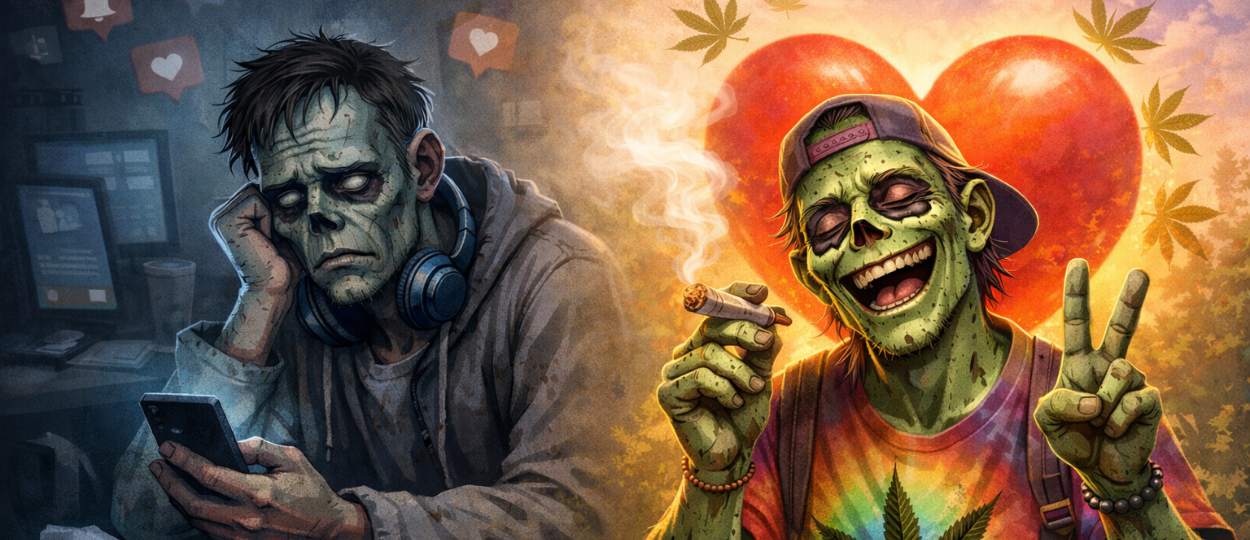
Never before in human history have we been exposed to so many sensory stimuli at once, and never, ever, have we felt so little. We live perpetually overloaded with screens, multitasking, demands for constant performance, and hyperproductivity. Thus, the mind remains permanently switched on, without the possibility of taking restorative breaks. And from so much noise and so little substance, a kind of permanent mental chatter arises that pushes us toward a progressive disconnection from our most basic emotions.
Current culture encourages and demands speed, performance, a violent “gimme now, gimme more.” But feeling, on the other hand, implies time, pause, and introspection. Emotional anesthesia, then, functions as an adaptation: to maintain performance, we turn off what we feel. Screens activate the brain’s reward system, generating rapid spikes of dopamine, which shift attention outward and prevent us from feeling discomfort, emptiness, or sadness. Over time, the brain loses its ability to self-regulate and becomes dependent on external stimuli.
“Emotional avoidance is silent and cumulative. It doesn’t appear suddenly: it builds up like a layer that affects the body, relationships, mental health, and identity,” explains Dr. Ángeles García Vara, a specialist in psychiatry with postgraduate training in medicinal cannabis. The main costs? Emotional numbness, lack of vitality, desire, and joy, intolerance of discomfort, somatization, impoverished relationships, and psychological dulling. Just to name a few.
“The less we feel, the less we tolerate feeling. Avoided emotions return with greater intensity. That’s why the body becomes the spokesperson, because the body speaks when the voice is silent. And that’s when insomnia, bruxism, irritable bowel syndrome, hypervigilance, headaches, fatigue, chronic tension, and pain appear,” she says.
“To avoid our own emotions, we also avoid those of others: less intimacy, less listening, more inner loneliness, fear of showing vulnerability. And these avoidances halt emotional development, generating repetition of patterns, rigidity, and disconnection from desire. We try to avoid feeling so as not to suffer… and we end up suffering because we stop feeling.”
In this sense, many patients describe that antidepressants cause them “some kind of relief” but that they also feel a “decrease in emotional intensity.” This is not true anesthesia: it is less exposure to anxiety and reactivity.
So: can weed do anything to contribute to this well-being? “Well, it can facilitate pausing, which is essential for registering what is happening inside us. Pausing is not about stopping life altogether: it is about slowing down the automatic reaction in order to perceive, name, and understand what we feel,” explains García Vara.
This is because phytocannabinoids, by modulating the endocannabinoid system, reduce the state of hypervigilance, muscle tension, and mental chatter. As a result, it opens an internal space for introspection where bodily presence emerges without the need for screens or instant gratification.
Thus, introspection depends not only on dosage and routes of administration, but also on intentions and frameworks. Furthermore, there are intentions that enable therapeutic processes. Some are valid: To be able to pause and validate the emotion that arises, to put words to what I feel, to open up internal space. But some intentions reinforce avoidance: I use it to avoid thinking, to calm down quickly, to suppress emotions, to sleep without registering my day.
“In clinical practice, I prefer to prescribe low doses or microdosing, keeping in mind that cannabis is a ‘tailor-made suit for each person.’ Then, I gradually modify the dose, establishing with each person which route of administration would be most appropriate. For example, the inhalation route is faster and more intense,” explains the psychiatrist.
As such, cannabis can facilitate introspection and the ability to sense what is happening inside the body. When we live in a state of constant alertness, introspection becomes distorted, causing either too much noise (tachycardia, irritability, tension, rumination) or too much blockage (the ineffable and infamous “I feel nothing”). The endocannabinoid system regulates the relationship between the sympathetic and parasympathetic nervous systems and modulates regions such as the amygdala, insula, and prefrontal cortex. This allows us to “feel” our bodies and register our emotions before acting.
However, it doesn’t work the same way for everyone and could even be harmful. “I wouldn’t recommend it for people already numbed by screens, with rapid dopamine release, who multitask, or have compulsive productivity. In these cases, there is often a loss of the capacity for wonder, intolerable boredom, emotional emptiness, low self-esteem, poor introspection, and a sense of ‘feeling nothing.’ In these cases, any substance that further lowers the dopamine levels would be detrimental.”
“Increased sensitivity can reinforce disconnection,” warns García Vara. From there, she poses some key therapeutic questions: “After using cannabis, do I feel more present… or more detached from myself?”, “Does it increase my sensitivity or diminish it?”, “Is there more bodily awareness… or more fog?”, “Do I use it to avoid feeling… or to feel better?” Consequently, if fog, escape, or disconnection predominate, there is harm, and its use should be avoided.
Ultimately, weed should be understood as a tool, not a solution, and it is essential to prevent it from becoming the only way to regulate difficult emotions. “Cannabis should accompany emotional regulation, not replace it,” she cautions. “The strongest predictor of psychological dependence is using it every time a difficult emotion arises. Cannabis regulates emotions so they can be processed, not to replace emotional work,” she continues.
To avoid dependence, health professionals recommend: avoiding methods of immediate gratification (vaping, very high THC levels), opting for mild and sustained effects, and not using it every time an uncomfortable emotion arises.
“Feeling is a voluntary and courageous act,” the psychiatrist adds. “Emotions arise on their own, but opening ourselves to feeling them is a decision that allows us to name them, reframe them, choose consciously, decide clearly, get out of autopilot, improve relationships and boundaries, strengthen introspection, and reduce dopaminergic impulsivity. Feeling sometimes hurts, but it also reorganizes, orients, and humanizes.”
And cannabis can be used as a vehicle toward that feeling, and from a scientific perspective, “healing the capacity to feel” can even be defined as a therapeutic goal. “In microdoses or low doses, and with balanced strains, cannabis use can decrease alertness and rumination, slow down internal time, relieve physical tension, open up the space for awareness and presence, and facilitate introspection without escape,” she explains. Often, professionals add other tools to this approach, such as psychological support (if needed, of course) and parallel introspective habits (breathing exercises, journaling, therapy).
We have to climb out of the inner hole, redirect our energy, refine the addictive loop, honestly reject FOMO (there’s nothing that important there, really, come on!), and avoid cognitive overload. If the digital whirlwind has turned us into emotional zombies with existential lag and dependent on likes, little hearts or reels, weed ends up offering us a portal, a chemical reset: it’s time to scroll down and turn up the volume on our feelings.
