


Whether stepping down from traditional nicotine or wanting to know exactly what you’re inhaling, the nuances of vaping can be overwhelming. Currently on the market, there are labels like “nicotine-free”, “nixamide”, or even “metatine”. All promising the same satisfaction without the stigma of traditional tobacco, there are also headlines for “synthetic analogues” or “chemical loopholes”. At this point, it’s hard to tell if you’re making a healthier switch or just going to an unknown risk. As confusing as it can be, you shouldn’t need a degree to buy a vape. With transparency in our products, we’ve seen trends come and go, and this article guides you through the latest research on synthetic nicotine and what’s just marketing.
Defining the New Players: Nicotine vs. Substitutees
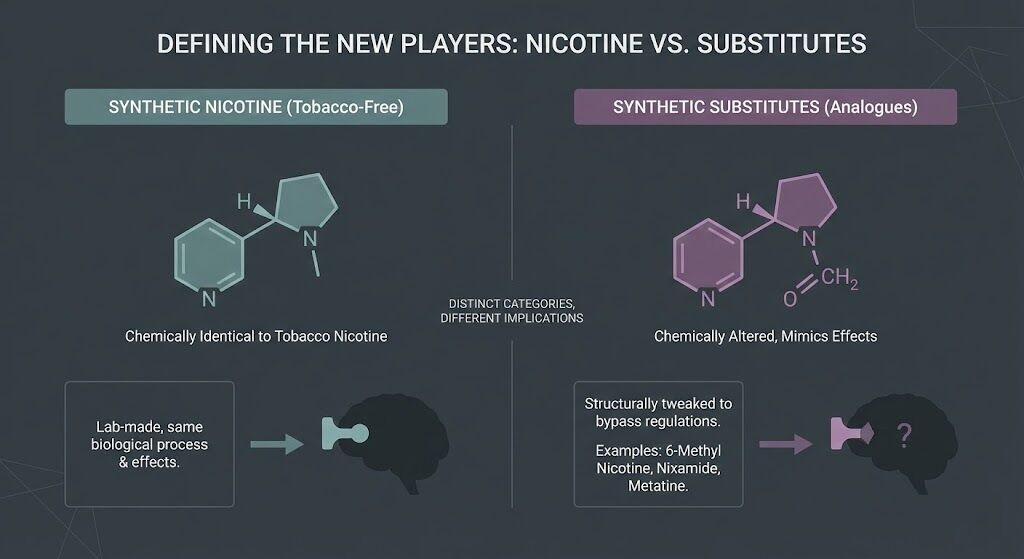
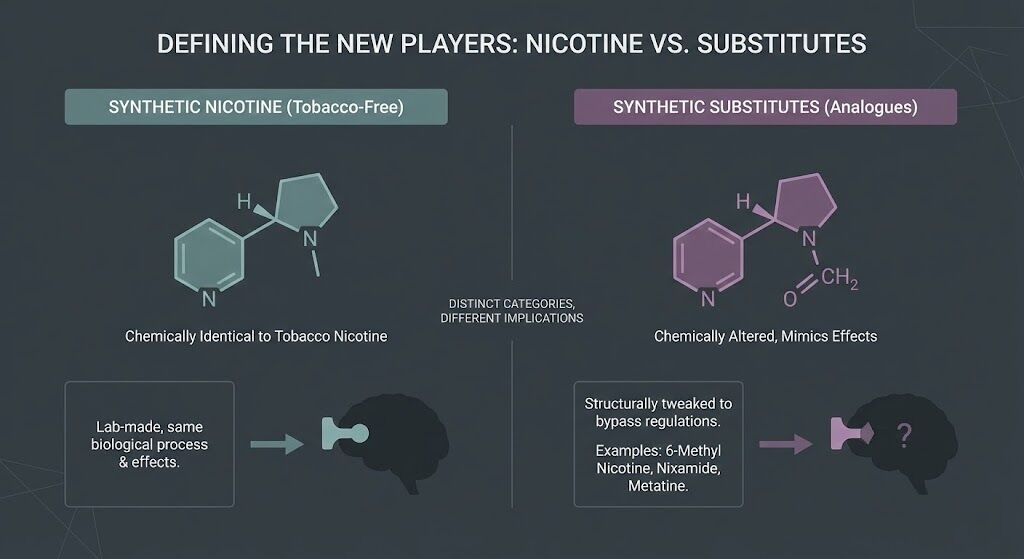
Before diving into the latest research, it’s essential to note that “synthetic nicotine” and “synthetic nicotine substitutes” are not the same thing. Often categorized under the same broad discussions, they are different products even if categorized as the same.
Synthetic Nicotine (Tobacco-Free Nicotine) is chemically identical to the nicotine found in tobacco plants. It is made in a lab rather than extracted from a leaf. Your body processes it precisely the same way it processes tobacco-derived nicotine. It carries the same risks and the same satisfaction profile because, at a molecular level, it is the same compound.
Synthetic Nicotine Substitutes (Analogues) are different. These are compounds that are structurally similar to nicotine but have been tweaked at a molecular level. The goal for manufacturers is often to create a chemical that hits the same brain receptors (giving you that familiar “throat hit” and satisfaction). Still, it is technically distinct enough to bypass specific tobacco regulations.
The most common substitutes currently showing up in vapes include:
-
6-Methyl Nicotine (6MN): A chemical analogue where a methyl group is added to the pyridine ring of the nicotine molecule. Research suggests this small change might make it significantly more potent than standard nicotine.
-
Nicotinamide (Vitamin B3 derivative): Often marketed under names like “Nixamide.” While Nicotinamide itself is a form of Vitamin B3 and generally non-psychoactive, recent testing shows some products labeled as such may contain other analogues to provide a “kick”.
-
Metatine: A trade name often associated with 6-methyl nicotine formulations, marketed as a non-nicotine alternative despite having similar biological effects.
The Science of Potency: Is “Stronger” Better?
One of the primary reasons people vape is the effect and sensation that’s caused when nicotine binds to nicotinic acetylcholine receptors in the brain. This conditioning of the brain is what many manufacturers of substitutes are trying to replicate, in order to help users wean off of traditional nicotine.
Recent findings indicate that 6-methyl nicotine might be significantly more potent than traditional nicotine. Animal studies have shown that 6MN is roughly three times more powerful in replacing nicotine in brain membranes and up to five times more potent in causing specific behavioral effects.
The potency matters here because of what it does for dependence, where marketing claims often suggest that substitutes are “lighter” or “non-addictive.” Whether true or not, the biological reality is that these products are designed to trigger similar dopamine pathways, but may come with greater intensity. If these new substances bind more tightly to your receptors, the potential for a higher tolerance and stronger withdrawal symptoms increases. Which, in terms, can make users tethered to a new chemical that is harder to put down than the old one.
Toxicology Profiles: Unknown Risks in Every Puff
This is the most significant question mark. We have decades of data on the effects of nicotine. We have very little on the long-term inhalation of these new analogues. The assumption that “non-tobacco” automatically means “safer” is being challenged by emerging toxicological data.
Preliminary research on 6-methyl nicotine has raised flags regarding cytotoxicity (cell damage). In tests on human bronchial epithelial cells, some analogues showed higher toxicity levels compared to standard nicotine. Specifically, thermal degradation of 6-methyl nicotine in e-liquids was found to produce significantly higher amounts of Reactive Oxygen Species (ROS) in aerosols compared to nicotine. ROS are unstable molecules that can cause oxidative stress, leading to cell damage and inflammation in the lungs.
However, the inconsistency of product formulations is a significant issue in current research. A study analyzing products labeled as “Nixamide” or “nicotinamide” found that the actual chemical makeup varies. Some contained only Vitamin B3 derivatives (which do not provide a nicotine-like buzz), while others were spiked with 6-methyl nicotine to ensure the user felt an effect. This inconsistency makes it nearly impossible for a consumer to know what they are actually vaping.
For a deeper look into the specific findings on Nixamide, you can read our breakdown of Nixamide Vape Research: Promise, Pitfalls, and Where the Science Stands.
The Regulatory Loophole: Why You Are Seeing These Now
You might be wondering why these products are suddenly flooding the market. The answer lies in legal definitions.
The FDA regulates tobacco products, which include anything made or derived from tobacco, as well as synthetic nicotine. However, because compounds like 6-methyl nicotine are chemically distinct enough from nicotine, manufacturers have argued they fall outside the FDA’s current authority over “tobacco products.” This has created a “grey market” where products are sold without the rigorous Pre-Market Tobacco Product Application (PMTA) process that standard e-liquids must undergo.
The gap in oversight shows why you see packaging that looks different from compliant vape products, which at times feature cartoons or flavors that have been banned. Nonetheless, it’s important to note that these windows are closing. Some states, like California, are pushing to update their prohibited products to include these “nicotine analogs.
Why This Matters for Your “Quit Journey”
If you are using these products to step away from nicotine, the distinction between a non-active substitute and a psychoactive analogue is vital.
If you switch to a vape containing nicotinamide (and only nicotinamide), you are essentially vaping a vitamin. You will not get a buzz, and you will not satisfy a chemical craving. This might be helpful for breaking the physical habit of hand-to-mouth action, but it will not help with chemical withdrawal.
On the other hand, if you switch to a product containing 6-methyl nicotine, thinking you are “quitting nicotine,” you might simply be swapping one dependence for another, potentially a stronger one. The lack of regulation means you might not know which one you are getting.
We explore this confusion further in our article on Synthetic Nicotine vs Alternatives: What Vapers Are Actually Trying to Figure Out, which breaks down how to read between the lines of product labels.
Navigating the Future of Vaping
Regulations will tighten, and so will the oversight on traditional tobacco and synthetic nicotine. Nonetheless, we expect more analogues to keep entering the market. As always, the research on synthetic nicotine substitutes will continue to develop, and it’s important to push for transparency. The “PMTA Exempt” label typically refers to the “gray area,” and if you’re considering switching to a synthetic nicotine substitute or a healthier alternative, it’s essential to understand exactly what you’re inhaling and what’s in your products.
If your goal is a healthier lifestyle, knowledge is your best tool. Don’t rely on the front of the box. Look for lab results (COAs), research the specific ingredients (like Metatine or 6-methyl nicotine), and understand that “nicotine-free” does not always mean “free of psychoactive chemicals.”
