


By Jorge Cervantes in collaboration with Innexo BV & Stefan Meyer
A “No-Veg” method flips plants straight to 12/12, trading smaller individual yields for higher annual output and a dramatic jump in top-shelf buds.
I have spent the better part of forty years walking through cannabis gardens. From the hidden guerrilla patches of the Emerald Triangle to the sun-drenched greenhouses of Southern Spain, and finally, to the high-tech, clinically sterile indoor facilities of the Netherlands and North America. In all that time, across every continent and every era of prohibition and legalization, there has been one constant, one Golden Rule that every grower—from the novice with a closet tent to the master horticulturist—has followed with religious adherence: You must veg your plants.

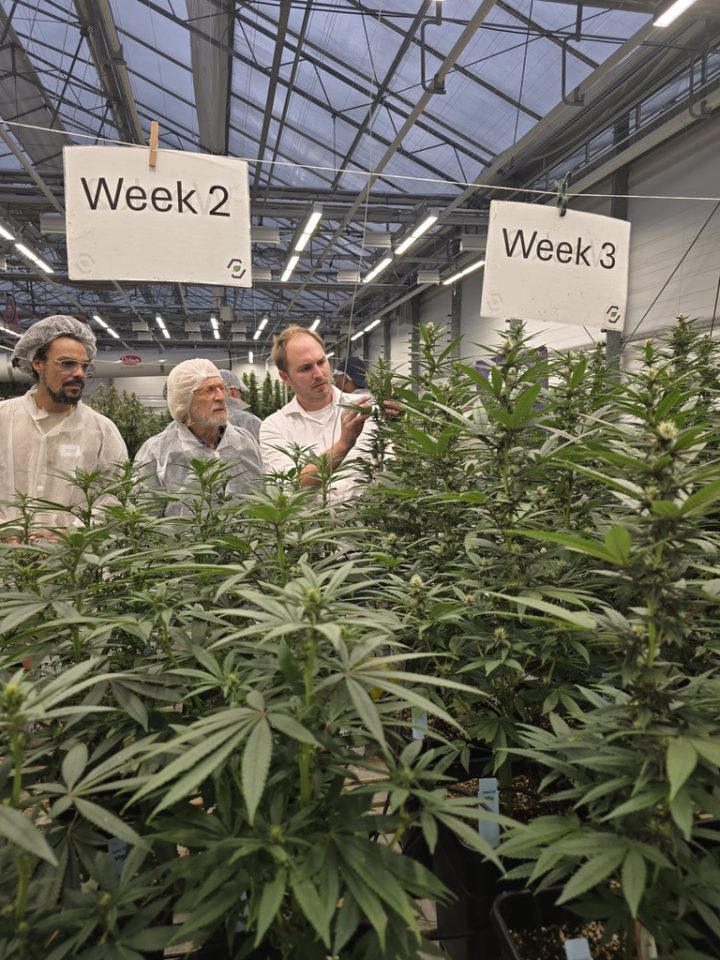
Dominique van Gruisen, owner of Innexo, BV (R) in Southern Netherlands shows Jorge Cervantes and Guido Berenstein (cnnbs.nl) at Acceleration Days details of his No-Veg research.
Top growers are getting six crops a year using the No-Veg technique. The image above shows a weekly progression of cannabis plants grown without any vegetative growth.
We have been taught that the vegetative phase is the foundation of yield. It is the time when we build the house frame before we put on the roof. We nurture our seedlings or clones under 18 or 24 hours of light, coaxing them to build strong root systems, thick stems, and a lush canopy of fan leaves. We top them, we train them, we weave them through scrog nets, and we wait. We wait two weeks, four weeks, or sometimes six weeks, paying for electricity, nutrients, and labor, all while the plant produces not a single gram of flower.
We do this because we believe a larger plant means a higher yield. We believe that if we flip to 12/12 too early, we will end up with a “micro-plant”—a single lollipop bud on a stick that isn’t worth the dirt it’s planted in.
But what if I told you that everything we thought we knew about the necessity of the vegetative phase was wrong?
What if the vegetative phase, rather than being an essential biological requirement, is actually a relic of outdated technology and misunderstood plant physiology?

Interns and employees pictured L to R are Seongbae Park, Dennis Laidlaw, Timo Hoofwijk and Ramon van Esch showing a Kerala plant grown in the Innexo research center. The South Indian landrace was grown using the No-Veg technique and harvested at 114 days. Kudos to Mr. Park and Mr. Hoofwijk for their trials and expert data analysis.
I recently had the privilege of reviewing groundbreaking data coming out of the Netherlands—the spiritual home of indoor horticulture. A consortium of heavy hitters in agricultural research, including Innexo, Fluence, and Grodan, has been conducting trials that are shaking the very foundations of our cultivation methods. They call it the “No-Veg” technique.
The premise is radical in its simplicity: You take a rooted clone or a germinated seed, and you place it immediately—on Day One—under a 12/12 flowering light cycle. Zero days of 18/6. Zero days of vegetative transition.
TL;DR

The Numbers Don’t Lie
The results from Innexo’s controlled trials are not just comparable to traditional methods; in many key metrics, they are superior. We are talking about potential electrical savings of up to 30%. We are looking at a nearly 37% reduction in labor costs. And perhaps most shockingly, we are seeing an increase in annualized yield—harvesting more grams per square meter per year—by fitting six crop cycles into a calendar year instead of four.
Performance Metrics: Traditional 2-Week Veg vs. No-Veg
| Metric | Traditional (2-Week Veg) | No-Veg Technique | Change |
| Yield (per cycle) | 712 g/m² | 622 g/m² | -13% |
| Annualized Yield | 4,111 g/m²/year | 4,621 g/m²/year | +12% |
| Grade A Flower | 20% | 35% | +75% |
| Grade C (Larf) | 25% | 5% | -80% |
| Cultivation Labor | 414 minutes/m² | 262 minutes/m² | -37% |
| Light Energy | 533 kWh/m² | 373 kWh/m² | -30% |
Source: Innexo, Fluence & Grodan controlled trials
Read that again. Yes, each individual harvest is smaller. But because you’re running six cycles per year instead of four, your annual production actually increases by 12%—while using 30% less electricity and 37% less labor.
“Keeping plants vegetative to produce biomass—i.e., foliage—that is later removed is counterproductive. The vegetative phase requires roughly 50% more hours of light than flowering, which has a big impact on a grower’s energy costs.”
— Dominique van Gruisen, CEO, Innexo
The Hidden Costs of Traditional Vegetation
To understand why we would want to eliminate the vegetative phase, we first have to look at the inefficiencies of the traditional model. As growers, we often fall in love with our plants. We love big, bush-like trees with thick trunks. But from a strict agronomic perspective—farming for biomass and resin per cubic meter—a large vegetative plant is inefficient.

Vegetative growth stage is not necessary when growing with the revolutionary No-Veg technique.
In a standard indoor cycle, a grower might veg for four weeks. During this month, electricity is burned: lights running 18 hours a day represents massive operational expenditure even with efficient LEDs. HVAC is taxed: those lights produce heat requiring cooling, and plants transpire, creating humidity that must be removed. Space is occupied: every day a plant sits without flowering is a day of lost revenue generation. And labor is consumed: large plants require topping, pruning, and defoliating.
Think about it: we are essentially paying the plant to grow leaves and then paying an employee to cut them off. Eliminating just two weeks of the vegetative phase can remove up to 252 hours of direct electricity per light per crop cycle. When you extrapolate that across a commercial facility with hundreds of lights, the numbers are staggering.
Quality Over Quantity: The Grade Revolution
But yield is only half the story. In the traditional big-plant model, light struggles to penetrate the deep canopy. The top colas are Grade A, the mids are Grade B, and the bottom third of the plant is often Grade C “larf”—loose, airy buds that are a nightmare to trim and sell for a fraction of the price.
In the No-Veg trials, the reduction in plant complexity led to a 75% increase in Grade A flowers and an 80% decrease in Grade C flower (larf). This is a massive improvement in “saleable biomass.” You are trimming less trash and curing more cash crops. The harvest index—the ratio of flower to total plant biomass—jumps to 60-80%.
The Secret: Harnessing the Stretch
How does a plant that never vegetates grow big enough to yield? The secret lies in understanding the “stretch”—that explosive period of vertical growth that happens when cannabis transitions to flowering.
In traditional growing, we often fear the stretch. We use growth regulators or restrictive climates to stop our plants from hitting the lights. In the No-Veg technique, the stretch is our engine. We are harnessing that hormonal surge to build the plant’s entire structure as it begins to flower.
The No-Veg technique uses the natural stretch of flowering cannabis to increase flower growth while diminishing leaf growth. This terpinolene-dominant phenotype 50-day Haze, AG2 is terpinolene dominant
The Taproot Sensor: For those growing from seed, the No-Veg technique relies on a fascinating biological mechanism. The root system of a cannabis seedling is not just an anchor; it is a sensory organ. When a seed germinates, the taproot shoots downward, guided by geotropism. Its job is to scout the depth of the soil profile. In nature, a deep soil profile signals abundant resources, telling the plant it is safe to grow large.
The No-Veg protocol for seeds dictates that you plant directly into the final container—ideally a large volume like 3 gallons (11-12 liters). When the taproot dives into this deep, unrestricted volume, it sends a signal of “abundance.” Even though the lights are on a 12/12 cycle (which usually signals “winter is coming”), the root signal of unlimited space overrides the photoperiodic stress. The plant enters a manic phase of growth, producing vegetative biomass rapidly to fill the space it senses is available.
The Hormonal Ballet: When we flip a plant to 12/12, the levels of florigen (the flowering hormone) rise, accumulating in the shoot apical meristem. Simultaneously, the rapid vertical growth is driven by auxins and gibberellins, which elongate the cells in the stem. Because the No-Veg plant hasn’t established a complex lateral branch structure, it puts all its energy into the main stem and primary branches. This creates a “columnar” architecture. The plant naturally optimizes its leaf-to-flower ratio. It doesn’t waste energy growing fan leaves that will be shaded out later—nature is doing the pruning for you.
The Perfect Root: Your Foundation for Success
If you are growing from clones—which is the standard for most commercial applications of No-Veg—you do not have the taproot advantage. You have a fibrous root system. Here, the margin for error is zero. You cannot transplant a weak clone into a high-intensity No-Veg room and expect it to survive.
“The most important lesson we learned in the trial is that there is zero margin for error in the first couple of weeks. Any issues that occur then will lead to problems in the rest of the cycle.”
— Frank Janssen, Product Development Manager, Grodan
The optimal root mass picture scale (0-5) is used to visually determine the theoretically optimal day for transplanting using the No-Veg technique. According to the study by Timo Hoofwijk, the optimal root score of 2 or 3 below is the best to achieve maximum results.


Example root score 0 – No roots visible at the bottom or lateral sides of the rockwool plug (Hoofwijk, August 2025). Do not plant.


Example root score 1 – One to two root tips visible; root length not exceeding 1 cm (Hoofwijk, August 2025). Do not plant.
Example root score 2 – 10-20 visible main root tips (Hoofwijk, August 2025). Optimal, perfect roots to plant.

Example root score 3 – 20-30 visible main root tips (Hoofwijk, August 2025). Optimal, perfect root to plant.

Example root score 4 – 40+ visible roots; roots protruding from all sides; minimum 10 dead root tips (brown ending of the tips) (Hoofwijk, August 2025). Do not plant.


Example root score 5– 40+ visible roots; roots protruding from all sides; minimum 20 dead root tips (brown ending of the tips) (Hoofwijk, August 2025). Do not plant.

Here is one more example of perfect roots. This Skunk clone struck after 10 days.
The Perfect Root: The Goldilocks zone. Roots have fully colonized the plug, but they are not circling. They are exploding outward, fuzzy with microscopic root hairs, and bright white, indicating high oxygen and active metabolism. When this plug touches the final substrate, the roots will bite into it immediately. Verdict: Plant Immediately.
Jorge’s Tip: “Always start 20% more clones than you need and ruthlessly cull anything that isn’t perfect. Uniformity in the root zone leads to uniformity in the canopy.”
Precision Growing: Crop Steering is the Control Panel
To execute this technique, you cannot rely on guesswork. You need Precision Growing. This usually means using an inert substrate like stone wool (rockwool), which has zero Cation Exchange Capacity (CEC). What you pour in is what is available to the plant, allowing you to “steer” the plant with absolute precision through Electrical Conductivity (EC) and Water Content (WC)—the language of the plant.
Vegetative Steering signals the plant to grow roots and leaves: Low EC (easier to drink), high water content, small dry-backs. This action signals abundance and safety. Generative Steering signals the plant to produce flowers and resin: high EC (osmotic pressure), low water content, and large dry-backs (letting the medium dry from 70% to 40% overnight). This drought stress mimics a dry autumn and signals to the plant to reproduce.
In the No-Veg method, we switch these gears fast—starting vegetative in Week 1, transitioning Weeks 2-3, then hard generative from Week 4 onward.
Your Week-by-Week No-Veg Roadmap

Day one, Transplanted.

Week 1: The “Do or Die” Phase — Light at 400-500 PPFD on a 12/12 cycle. High humidity, Vapor Pressure Deficit (VPD) 0.8-1.0 kPa. Temperature 77-79ºF (25-26°C). Day 1-3: do not water if possible. Let the roots “search” for moisture. This is the scouting phase. If you overwater now, the roots get lazy and the plant stalls. Watch for new root tips exiting the block. If a plant looks sad on Day 3, cull it—it will never catch up.

Week 2: The Ignition — Increase to 600-700 Photosynthetic Photon Flux Density (PPFD). VPD 1.0-1.2. Start frequent, small irrigations. Keep EC moderate (2.0-2.5). High nitrogen is still needed as the plant builds its stem. The plant should be growing visibly every day.

Week 3: The Full Stretch — Full power at 800-1000+ PPFD. Turn on inter-canopy lights if available. Toward the end of this week, increase EC (2.8-3.0) to signal the plant to stop cell expansion and begin hardening. Introduce larger overnight dry-backs.

Week 4: The Stack — The plant should reach its final height (70-120 cm). You will see “buttons” of white pistils forming at every node. Maintenance is minimal. Because the plant didn’t veg, there are no massive fan leaves blocking the bottom. Don’t strip the plant naked! These leaves are the factories making sugar for your buds. The No-Veg plant has the perfect ratio naturally.


Weeks 5-7: Bulking — Big shots, less frequent. Push the dry-backs (20-25% overnight). This stress forces the plant to pump energy into flowers. Lower the temperature to 75ºF (24°C) to preserve terpenes. Lower humidity (VPD 1.3-1.5) to prevent mold.

Weeks 8-9: Ripening — Lower EC (1.5-2.0) to let the plant cannibalize its stored reserves. Dial back light intensity slightly to preserve terpenes. Watch the trichomes—when they are milky with a hint of amber, chop it down.
The Risk and The Reward: Is This For You?
Let me be direct: the No-Veg technique is not for everyone.
The Risks: There is zero recovery time. In a veg cycle, if you burn your plants with nutrients in Week 2, you can just veg them for an extra week to let them recover. In No-Veg, you are on a conveyor belt—a mistake in Week 1 reduces your final yield permanently. If you live in a jurisdiction with plant count limits (4, 6, or 12 plants), No-Veg is not for you. You need big trees to maximize your legal limit. No-Veg relies on high plant counts (8-10 per square meter) to achieve its yields. You also need more starting material—instead of 4 plants per light, you might have 16.
The Rewards: Six harvests a year mean cash flow every 8 weeks. Smaller plants are easier to control. Lower electric bills, lower labor bills. Grade A buds from top to bottom. Reduced pest and disease risk because shorter cycles give problems less time to establish.
“In the next five years, I think it’s likely to become the industry standard for all growers who aren’t limited by plant count. Around 2,000 industry professionals have visited our demo center over the past year, and everyone who has seen this approach in action leaves convinced that this is the way forward.”
— Dominique van Gruisen, CEO, Innexo
The New Standard
The cannabis industry is maturing. We are moving from the basement to the boardroom, from art to science. The work being done by Innexo, Fluence, and Grodan suggests that our old habits—such as the long vegetative phase—might be holding us back.

Dominique, Jorge, and Stefan Meyer are enjoying the No-Veg heavy harvest!
For the home grower with no plant-count limits, or the commercial facility looking to survive in a competitive market, the No-Veg technique offers a path to greater efficiency. It requires you to be a better grower. You have to master your roots, your climate, and your irrigation. You can’t be lazy. But if you can execute it, the rewards are undeniable.
This is not a technique for the lazy—it’s a high-performance Formula One strategy that requires precision, an understanding of root morphology, and a complete shift in how we think about light and plant architecture.
The future of cultivation is efficiency.
The question is, are you ready to let go of the sacred veg?
Grow smart. Grow efficiently. And as always, grow big (yields)!
— Jorge Cervantes
