


The Maryland Senate has unanimously approved a bill to extend a psychedelics task force through the end of 2027 to develop updated recommendations on expanding therapeutic access to the novel drugs and potentially creating a regulatory framework for broader legalization.
Just days after moving through committee—which came on the same day that the House of Delegates passed that chamber’s version—the full Senate on Thursday approved the legislation from Sen. Brian Feldman (D) in a 44-0 vote.
Both chambers’ proposals are aimed at building upon a current law that created the Maryland Task Force on Responsible Use of Natural Psychedelic Substances.
That panel released an initial final report to state lawmakers last year, with recommendations for the phased implementation of a wide range of reforms to provide legal therapeutic access to substances such as psilocybin.
“The mission was to study the use of natural psychedelic substances and make recommendations regarding changes to state law, policy and practices to create a Maryland natural psychedelic substance access program and to make recommendations to transition from the criminalization of these substances,” Feldman said at a committee hearing earlier this month. “This is a really hard-working group of individuals.”
Members of the task force have already advised that it was ultimately recommending a “multi-pathway framework for safe, broad, and equitable access to natural psychedelic substances, with an initial focus on psilocybin.”
The psychedelics task force was formed following Gov. Wes Moore’s (D) signing of a pair of bills into law in 2024. The 17-person body, overseen by the Maryland Cannabis Administration (MCA), was charged with studying how to ensure “broad, equitable and affordable access to psychedelic substances” in the state.
SB 336 and HB 427 would continue that work, maintaining the panel through December 31, 2027. In the interim, the task force would be required to submit an updated report to legislators with additional findings and recommendations by October 31 of this year.
The Senate version of the bill has been amended to add a representative of a historically black college or university to the task force, so the House will need to sign off on that change before the legislation can head to the governor’s desk.
Beyond the extended timeline for the task force to study and develop the report, the current law would not change under the legislation.
The multi-step regulatory framework that members recommended last year “involves phased implementation of complementary elements from medical/therapeutic use and supervised adult use, to deprioritization, and to commercial sales,” the earlier report said. “This model broadly and inclusively serves the needs of Maryland’s diverse population while enabling unified safety standards, accountability, and viable economic pathways for small businesses.”
The first phase of the plan would be to create an advisory board to establish safety parameters, data monitoring, practice guidelines, licensing protections, public education campaigns, training for facilitators, law enforcement and testing facilities, as well as “immediate restorative justice measures,” the report states.
Under phase two, the state would implement “deprioritization measures” to mitigate the harms of criminalization, provide for supervised medical and adult-use consumption facilities, allow personal cultivation for “permitted individuals” and promote research processes.
Finally, phase three would be contingent on the “demonstrated safety outcomes and provider confidence” based on the prior steps. Should those factors be satisfied, the last phase would lead to a commercial sales program for adults “who maintain an active license to use natural psychedelic substances,” coupled with an evaluation of the state’s “readiness for expanding to additional natural psychedelic substances.”
“Safety and oversight measures ensure responsible and gradual expansion of access while maintaining capacity to identify and respond to emerging issues swiftly,” the report said. “This approach plans for long-term learning and improvement: starting small, utilizing built-in evaluation and accountability mechanisms from the outset, gathering real-world data, and committing to an iterative approach to policymaking.”
Notably, the task force said it did not support “delaying state action pending future federal [Food and Drug Administration] approval.”
“The Task Force recognizes that implementing such a comprehensive framework requires careful sequencing and coordination, with particular attention to scope of practice issues that may significantly affect the viability and safety of different pathways. However, the order of implementation must carefully consider professional regulatory frameworks and safety concerns raised by medical organizations and health care providers. The Task Force’s recommendation for simultaneous implementation of multiple pathways does not mean that all components must activate on the exact same day, but rather that Maryland should avoid the sequential approach seen in other jurisdictions where implementing one pathway causes others to ‘languish,’and/or bolster black and gray markets.”
Rather, the task force said, the multi-phase approach to psychedelics reform “establishes foundational systems that support all pathways equally, followed by a coordinated launch of medical, supervised adult use, and deprioritization pathways, with commercial sales following once product safety systems are operational.”
Members also said that the model envisioned could be used by other states to develop their own laws that “adapt to their own circumstances and values.”At this point, the task force is only looking at psilocybin, mescaline and DMT.
While the legislature empowered members to investigate potential regulations for other psychedelic substances, they decided to take a more conservative approach in their initial work.
As originally introduced, the House version of the task force legislation contained more prescriptive requirements to explore and issue recommendations on aspects of psychedelics policy such as “systems to support statewide online sales of natural psychedelic substances with home delivery” and “testing and packaging requirements for products containing natural psychedelic substances with clear and accurate labeling of potency.” That language was ultimately removed, however.
The task force legislation advanced about two years after a different law took effect creating a state fund to provide “cost-free” access to psychedelics like psilocybin, MDMA and ketamine for military veterans suffering from PTSD and traumatic brain injury.
—
Marijuana Moment is tracking hundreds of cannabis, psychedelics and drug policy bills in state legislatures and Congress this year. Patreon supporters pledging at least $25/month get access to our interactive maps, charts and hearing calendar so they don’t miss any developments.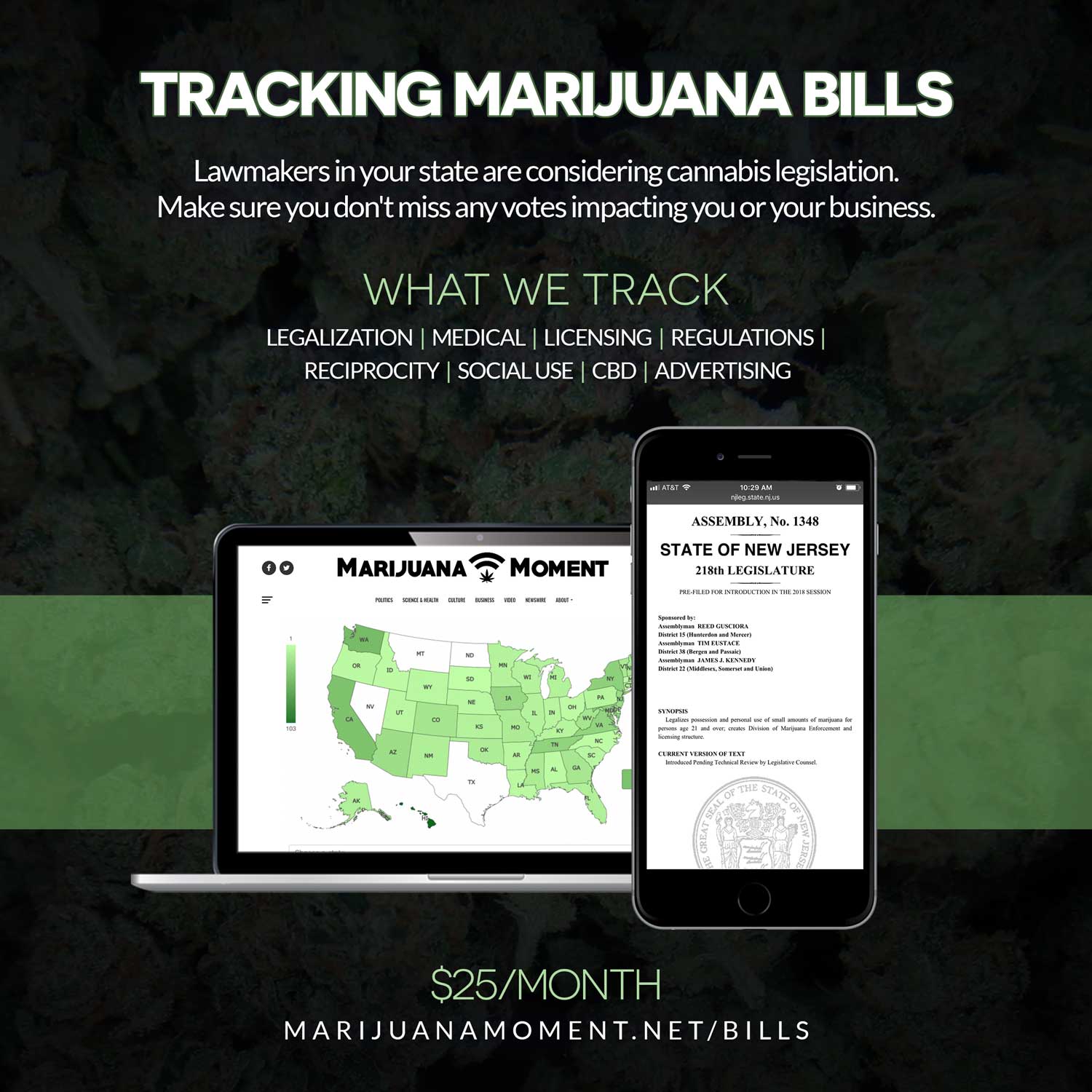
Learn more about our marijuana bill tracker and become a supporter on Patreon to get access.
—
Meanwhile, earlier this month, Maryland lawmakers took up a bill to protect the gun rights of medical marijuana patients in the state.
Members of the House Judiciary Committee discussed the legislation from Del. Robin Grammer (R), who has sponsored multiple versions of the cannabis and gun rights measure over recent sessions, but they have not yet advanced to enactment.
Separately, a Republican congressional lawmaker representing Maryland who has built a reputation as one of the staunchest opponents of marijuana reform on Capitol Hill—and whose record includes ensuring that Washington, D.C. officials are blocked from legalizing recreational cannabis sales—may be at risk of being unseated in November due to redistricting in his state.
Photo courtesy of Wikimedia/Workman.
