


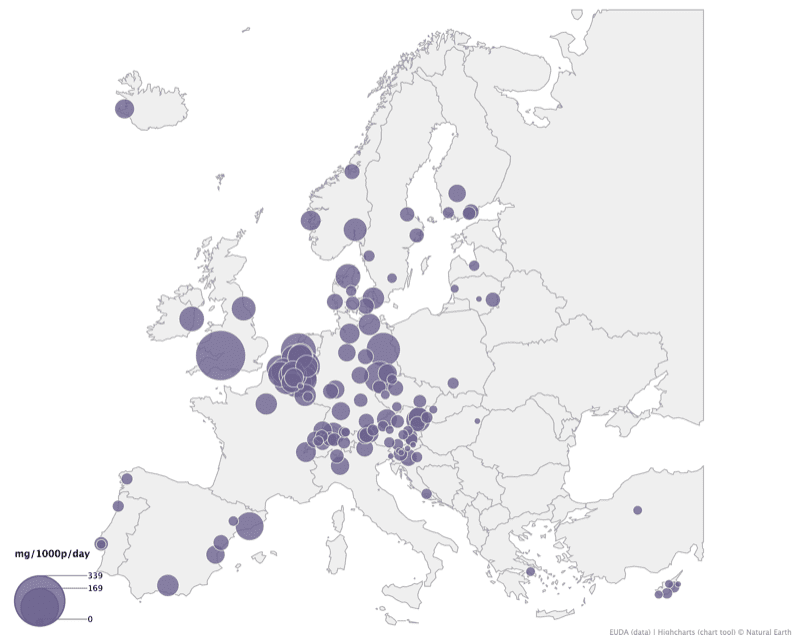
Ketamine use across Europe has surged nearly 41% in the past year, whilst MDMA detections have fallen 16% – the sharpest drop since pandemic lockdowns closed nightlife venues in 2020 – according to Europe’s largest wastewater drug study.
The findings come from an annual monitoring project analysing wastewater from 115 cities across 25 countries, including Türkiye, Norway and 23 EU nations. Cocaine detections also rose 22%, continuing an upward trend that began in 2016.
“Europe’s wastewater tells the story of a drug phenomenon that is widespread, varied and in constant flux,” said Dr Lorraine Nolan, EUDA Executive Director. “This year’s study, covering 115 European cities, reveals a marked decline in traces of MDMA, alongside continued signs that cocaine and ketamine detections are on the rise.”
Researchers at the project, run by the Europe-wide SCORE group in association with the European Union Drugs Agency (EUDA), collected daily wastewater samples from a population of 72 million between March and May 2025, analysing them for six drugs: cocaine, ketamine, amphetamines, MDMA, methamphetamine, and cannabis. Due to the instability of the metabolite 6-monoacetylmorphine in wastewater, heroin is not included in the study.
Despite all six drugs being detected in nearly every city, researchers noted substantial variability, with diverging trends observed across the continent rather than within individual countries.
Ketamine
Ketamine detections rose nearly 41% from 2024 to 2025, with the highest concentrations found in Belgium, Germany, and the Netherlands. Berlin and Amsterdam recorded particularly high rates compared to other European cities, though levels in Canadian and UK cities exceeded those in Europe.
No ketamine was detected in some Eastern European and Balkan cities, including Maribor, Slovenia, Debrecen, Hungary, and Kaunas, Lithuania.
MDMA
Despite European cities having some of the world’s highest MDMA detection rates – exceeded only by New Zealand – detections fell 16% from last year, the biggest drop since 2020’s pandemic-induced decline. In the 2021 survey, 66% of participating cities reported decreased MDMA levels.
The highest detection rates were in Slovenia, Belgium, and Spain. In Granada, Spain, 85mg of MDMA per 1000 people per day was detected, with weekend levels approximately 2.5 times higher than weekdays. Paris recorded 71mg daily, whilst Amsterdam detected 176mg, though Amsterdam showed less pronounced weekday-weekend fluctuation than other Western European cities.
 Distribution of ketamine residue detection across Europe
Unlike recent years, most countries with multiple study locations showed marked differences between large and small cities, with higher MDMA concentrations in larger urban areas. More than 75% of cities showed elevated weekend levels, reflecting recreational use patterns.
Cocaine
Cocaine use continued its nine-year upward trajectory, with detections rising 22% from 2024 to 2025. The substance was detected through its metabolite, benzoylecgonine (BE), with the highest concentrations in Western European cities, including the UK, the Netherlands, and Spain.
Middlesbrough, UK, recorded 2786mg per 1000 people daily, Lleida, Spain, detected 1405mg, and Amsterdam recorded 1171mg. Eastern European countries, whilst showing the lowest levels, are experiencing recent surges.
Weekend cocaine use often significantly exceeded weekday levels. In Arlon, Belgium, the daily mean was 749mg, but weekday levels were 457mg compared to weekend levels of 969mg – more than double. Similar patterns were observed with ketamine and MDMA.
“In approximately half the countries with multiple study locations, higher BE loads (amounts of BE per 1000 people) were found in the largest city compared with smaller cities. In addition to geographical patterns, wastewater analysis can detect fluctuations in weekly patterns of illicit drug use. More than 75% of the cities show higher loads of BE in wastewater during the weekend (Friday to Monday) than during weekdays, which may reflect a pattern of more recreational use,” the study author explained.
Among the 10 countries participating since 2011, cocaine use remained relatively stable between 2011 and 2015. However, 2016 marked a turning point, with increases observed in most cities annually since then.
Cannabis
National surveys identify cannabis as being the most used illicit drug in Europe, with an estimated 24 million users in the past year.

Researchers analysed wastewater for THC-COOH, a metabolite that law enforcement controversially uses to detect cannabis use in drivers.
THC-COOH was detected in all cities, with the highest concentrations in Western European countries, including the Netherlands, Germany, and Switzerland. Geneva recorded a daily mean of 252mg of THC-COOH per 1000 people per day, Amsterdam recorded 194mg, and Erfurt recorded 187mg.
Cities in Portugal, Spain, and the Netherlands saw decreases, whilst cities in some Balkan and Eastern European countries, such as Hungary, Slovenia and Croatia, experienced increases. Overall, THC-COOH levels remained stable across Europe.
The study author noted that THC-COOH levels in some US and Canadian cities exceed those in much higher in some US and Canadian cities than in European cities with the highest rates of detection.
“All European cities detected THC-COOH in wastewater. The THC-COOH loads observed indicate that cannabis use was highest in cities in the west and centre of Europe, in particular in cities in the Netherlands, Germany, but also in cities in Slovenia. Viewed in a global context, wastewater analysis indicates higher THC-COOH levels in cities in Canada and the United States than in the EU cities with the highest observed loads.”
The data didn’t show large fluctuations between weekday and weekend levels, which signals that cannabis use stayed stable across the week. Where there was fluctuation, it often showed cannabis use being higher on weekdays than at weekends.
Amphetamine and methamphetamine
Amphetamine and methamphetamine are both used in Europe, though methamphetamine use has historically concentrated in Czechia and, more recently, Slovakia. In recent years, methamphetamine use has spread into other European countries, including the Netherlands, Belgium, Switzerland, Spain, and Germany.
“Methamphetamine use, generally low and historically concentrated in Czechia and Slovakia, also appears to be present in Germany, Lithuania, Norway, Türkiye, Spain, Cyprus and the Netherlands. The observed methamphetamine loads in the other locations were low, with the most recent data showing signals of increases in cities in the north and centre of Europe. At the same time, 16 monitored European cities reported no detection of methamphetamine. Viewed in a global context, cities in Australia, Canada and the United States show higher methamphetamine loads than the EU cities with the highest observed loads,” the study author noted.
Amphetamine is used across the continent, with the largest concentrations in cities in Scandinavian countries, and in Germany, Belgium, the Netherlands and Switzerland. Riga, Latvia, also saw medium to high levels.
Medium levels were recorded in most Eastern European and Balkan cities, including Zagreb, Hungary, Krakow, Poland, and Brno, Czechia. Five cities in Cyprus also detected medium levels.
The highest levels of amphetamine were detected in Gävle, Sweden, with a mean of 449mg per 1000 people per day, with almost no fluctuation between weekday and weekend use. In contrast, 0mg was detected in Lugano, Switzerland, and Porto, Portugal.
“Of the 82 cities with data on amphetamine residues for both 2024 and 2025, 36 (44%) reported an increase in the loads of amphetamine found in 2025, 27 (33%) showed a decrease, and 19 (23%) remained stable. Of the 80 cities that reported data on methamphetamine residues in municipal wastewater for 2024 and 2025, 37 (46%) showed an increase, 28 (35%) a decrease and 15 (19%) a stable situation,” the study author summarised.
Limitations of wastewater analysis
Wastewater analysis is a highly regarded method of estimating drug usage within populations. However, due to its nature, it cannot identify individual dosage or drug purity. Wastewater analysis also encounters challenges arising from the instability of the selected biomarkers used to identify which drugs are present and in what quantities.
Wastewater-based epidemiology allows researchers to identify and quantify metabolic residues of illicit drugs in raw wastewater and back-calculate consumption by the population served by the wastewater treatment plant. However, for some cities, samples are not fully representative of drug use for the entire population.
Researchers are working to enhance monitoring approaches, including using mobile device data to better estimate the dynamic population size in sewer catchments at the time of sample collection.
