


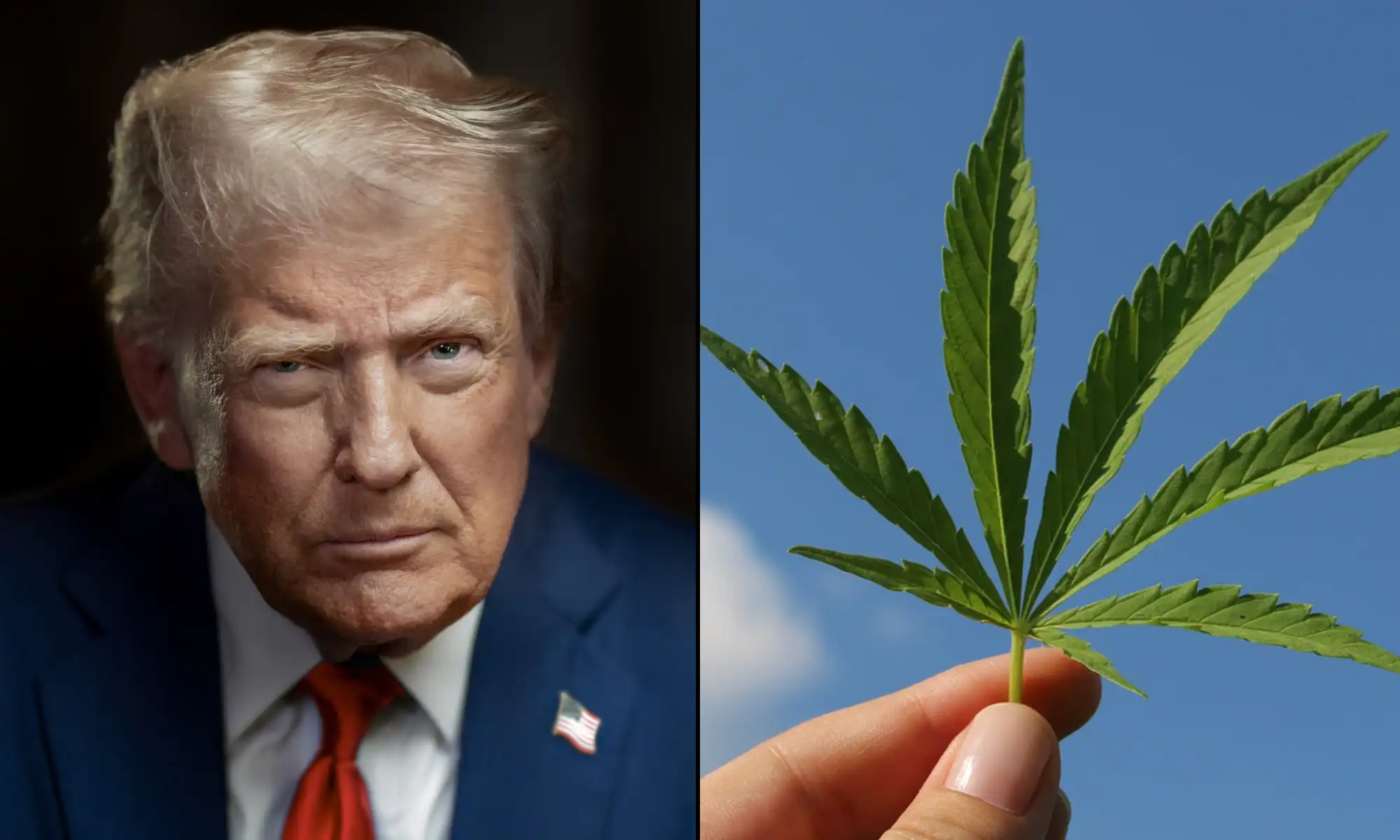
President Donald Trump is requesting that Congress continue to protect state medical marijuana programs from federal interference while also maintaining a policy that has blocked local officials in Washington, D.C. from legalizing recreational cannabis sales.
In his Fiscal Year 2027 budget request sent to lawmakers on Friday, the president proposed for the first time to maintain the rider that prevents the Department of Justice from spending any money to “prevent [states] from implementing their own laws that authorize the use, distribution, possession, or cultivation of medical marijuana.”
Last year and each year during his first term in office, Trump had requested that Congress delete the medical marijuana provision from annual appropriations legislation.
As it appears in the president’s new budget proposal, the medical cannabis rider reads:
“SEC. 528. None of the funds made available under this Act to the Department of Justice may be used, with respect to any of the States of Alabama, Alaska, Arizona, Arkansas, California, Colorado, Connecticut, Delaware, Florida, Georgia, Hawaii, Illinois, Indiana, Iowa, Kentucky, Louisiana, Maine, Maryland, Massachusetts, Michigan, Minnesota, Mississippi, Missouri, Montana, Nevada, New Hampshire, New Jersey, New Mexico, New York, North Carolina, North Dakota, Ohio, Oklahoma, Oregon, Pennsylvania, Rhode Island, South Carolina, South Dakota, Tennessee, Texas, Utah, Vermont, Virginia, Washington, West Virginia, Wisconsin, and Wyoming, or with respect to the District of Columbia, the Commonwealth of the Northern Mariana Islands, the United States Virgin Islands, Guam, or Puerto Rico, to prevent any of them from implementing their own laws that authorize the use, distribution, possession, or cultivation of medical marijuana.”
As is the case with the version most recently enacted into law, the proposed provision would continue to omit Nebraska, which has a medical cannabis law, for reasons that are unknown.
President Joe Biden had consistently proposed to continue the medical cannabis rider in his budget requests—though President Barack Obama, like Trump, had sought to delete it.
Congress has the final say on appropriations legislation language, however, and has not followed through on any president’s request to delete the medical marijuana protection since it was first enacted in 2014—though lawmakers have also declined to expand the protections to cover state recreational marijuana programs.
After signing prior appropriations bills into law that included the medical cannabis protection in contravention of his request to delete it, Trump on three occasions during his first term issued statements that specifically said his administration “will treat this provision consistent with the President’s constitutional responsibility to faithfully execute the laws of the United States”— implying he was reserving his right to ignore the rider.
Now, however, he is requesting that Congress continue the state medical cannabis protection policy, a move that comes months after the president issued an executive order directing the attorney general to complete the process of moving marijuana from Schedule I of the Controlled Substances Act to Schedule III.
Meanwhile, Trump is also proposing to continue a separate provision that prevents District of Columbia officials from legalizing and regulating adult-use marijuana sales in the nation’s capital.
The policy, which has been championed by Rep. Andy Harris (R-MD), appears in Trump’s budget request as follows:
“SEC. 809. (a) None of the Federal funds contained in this Act may be used to enact or carry out any law, rule, or regulation to legalize or otherwise reduce penalties associated with the possession, use, or distribution of any schedule I substance under the Controlled Substances Act (21 U.S.C. 801 et seq.) or any tetrahydrocannabinols derivative.
(b) No funds available for obligation or expenditure by the District of Columbia government under any authority may be used to enact any law, rule, or regulation to legalize or otherwise reduce penalties associated with the possession, use, or distribution of any schedule I substance under the Controlled Substances Act (21 U.S.C. 801 et seq.) or any tetrahydrocannabinols derivative for recreational purposes.”
While Congress has continually blocked D.C. from legalizing recreational marijuana sales with the annually approved rider, local officials have worked to expand access through the existing medical cannabis market by, for example, by allowing residents and even visiting tourists to self-certify without the need for doctors’ recommendations.
This week, Mayor Muriel Bowser (D) proposed local legislation to allow medical marijuana companies to partner with local breweries and distilleries to produce cannabis-infused, alcohol-free drinks.
It is possible that moving marijuana out of Schedule I, as the administration is still considering doing, would give D.C. a workaround to the provision as it is drafted, but some observers have raised questions about the implications of the rider’s use of the term “tetrahydrocannabinols derivative,” which is not defined in federal law.
The president’s budget additionally proposes to continue a rider protecting state hemp programs from federal interference.
The hemp provision reads:
“SEC. [737]724. None of the funds made available by this Act or any other Act may be used—
(1) in contravention of section 7606 of the Agricultural Act of 2014 (7 U.S.C. 5940), subtitle G of the Agricultural Marketing Act of 1946, or section 10114 of the Agriculture Improvement Act of 2018; or
(2) to prohibit the transportation, processing, sale, or use of hemp, or seeds of such plant, that is grown or cultivated in accordance with section 7606 of the Agricultural Act of 2014 or subtitle G of the Agricultural Marketing Act of 1946, within or outside the State in which the hemp is grown or cultivated.”
Finally, due to the way that presidents’ budget requests are formatted depicting proposed changes to previously enacted spending legislation, Trump’s new proposal also contains language showing the removal of provisions to redefine and recriminalize certain hemp THC products that he signed into law last year and that are set to take effect this November.
Because that legislation changed federal law on an ongoing basis, it does not need to be reenacted annually in the way that the policy riders do—so Trump’s budget deletes the provisions from being duplicatively included in FY2027 appropriations legislation.
The president’s budget request now heads to Congress, where lawmakers will craft a series of spending bills to actually fund the government with provisions that may differ from the president’s proposals.
