


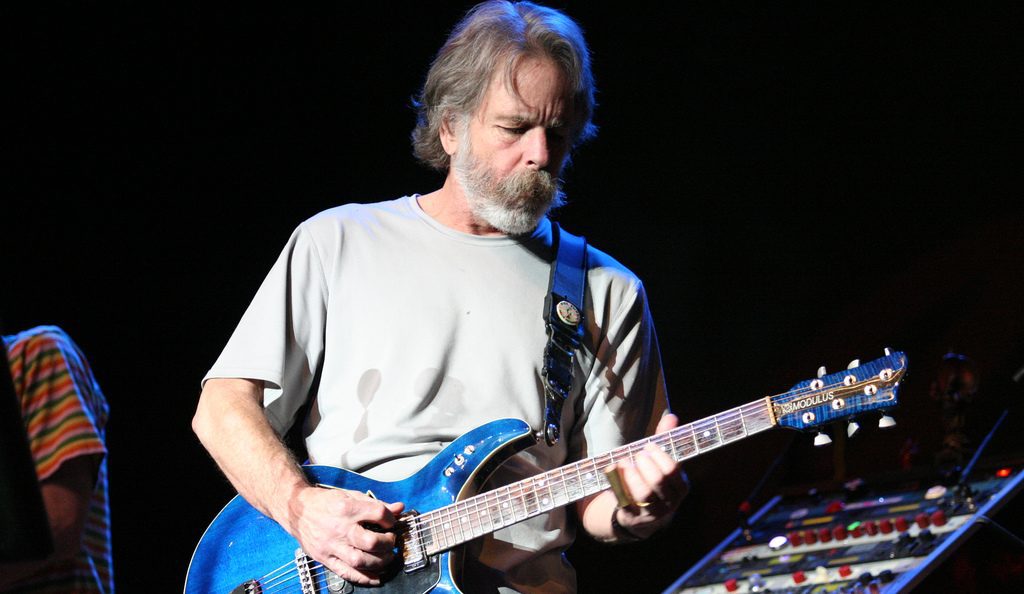
From LSD-fueled beginnings to a misunderstood HuffPost quote, a High Times–style look at Bob Weir’s nuanced relationship with cannabis, the Grateful Dead, and the culture they helped shape.
With singer, songwriter, guitarist, and concert legend Bob Weir’s passing into the next plane of existence on January 10, the last OG frontman of the legendary Grateful Dead (GD) has faded from the still-prosperous jamband scene he helped create, joining fellow GD singer and guitarist Jerry Garcia, who died in 1995, and bassist and singer Phil Lesh, who passed in 2024.
Mere months prior to his death, Weir capped off sixty years of a creative career spent playing psychedelic improvisational music with his final band, Dead & Company, whose farewell concerts were fittingly performed in San Francisco’s Golden Gate Park on August 1, 2, and 3, 2025.
For the last thirty years, the same length of time the original Grateful Dead existed, Bob Weir did his part to preserve the band’s remarkable catalog through live performances. That body of work stands as a postmodern entry in the Great American Songbook.
In recent weeks, much prose has been dedicated to Bob Weir’s life and legacy. As a High Times–style eulogy, this piece focuses first on Weir’s complicated and often misunderstood relationship with psychoactive substances such as cannabis and LSD, dating back to the 1960s.
Before becoming the Grateful Dead in 1965, the band was originally called The Warlocks. During those early days, Bob Weir was a committed weed smoker, according to GD drummer Bill Kreutzmann. In his Instagram tribute to Weir, Kreutzmann described their early exploits, which included pulling pranks and smoking joints in the alley behind a music store where the young band rehearsed. The pair also tripped together on STP, a powerful and unstable psychedelic common in those hazy early countercultural years.
One of the interview subjects for this article was David Gans, creator of the syndicated radio program The Grateful Dead Hour and a longtime host on SiriusXM’s Grateful Dead Channel. Gans is also a touring musician who has performed onstage with members of the Grateful Dead, including Bob Weir, notably during a late-night gig at San Francisco’s Hilton Hotel in December 1997. He also regularly teaches a college course on the Grateful Dead through Stanford University Continuing Studies.
Gans reflected on the complex relationship between the Grateful Dead and psychoactive substances:
“The categorization of the Dead as a ‘drug band’ is both technically true and utterly bullshit. The Grateful Dead were formed in a time of psychedelic urgency, and I firmly believe LSD was an important catalyst in the creation of their music. But to categorize them as a drug band, or as part of a drug culture, is to completely miss the point. We used drugs as tools, not anesthetics. This culture isn’t built around people losing their minds to drugs. It’s built around people using drugs to enhance their spiritual and creative lives.”
The Grateful Dead’s origins were forged while serving as the house band for the legendary 1965–66 Acid Test parties organized across California by author Ken Kesey and his Merry Pranksters. Dennis McNally, the band’s longtime publicist and author of A Long Strange Trip: The Inside History of the Grateful Dead, described how those experiences shaped the band’s ethos.
“What made the Dead unique was that the Acid Tests gave them the option to play or not play as they chose. They were not the show. Everyone tripping on LSD was the show. The band was simply the soundtrack, if they even chose to play. That informed their attitude toward the audience. There was no power imbalance. The audience were partners in a shared quest for magic.”
It is generally accepted that Weir stepped away from recreational drug use earlier than most of his bandmates, with the exception of original frontman Ron “Pigpen” McKernan, whose tastes leaned more toward alcohol than psychedelics.
Weir’s ruggedly individual persona allowed him to de-emphasize drug use even when cannabis and other substances were readily available.
“Bobby wasn’t a big pothead,” Gans said. “When I used to hang out at his house in the early 1980s, there was always really good weed around, but he didn’t smoke much.”
Gans added that while he personally considered Grateful Dead music “pothead music,” Weir never judged others for their use.
“Bobby was always known as the clean-living one. He was a mountain biker, a jogger, a football player. He still used drugs, but it wasn’t the center of his life.”
Gans emphasized that his own recollections reflected personal experience rather than a comprehensive portrait.
“I did cocaine with Weir a number of times, but it wasn’t central to his life in any way. Jerry was more a victim of drugs than the others. Bobby maintained his physical health and never encouraged excessive use.”
The primary controversy surrounding Weir and cannabis stems from a 2014 interview with HuffPost, in which Weir was quoted as saying, “I know guys who are thoroughly addicted to marijuana. If they had to stop now, they’d get the shakes, they’d get the sweats.”
While psychological dependence on cannabis is possible, the physical symptoms Weir described are more commonly associated with alcohol or opioid withdrawal.
Those comments were later cited by Promises Behavioral Health in an online blog post about marijuana addiction, positioning Weir as an authority on cannabis dependence. Dennis McNally expressed surprise at that characterization.
“I never saw Bob opposed to pot,” McNally said. “He was always around dope smokers and never complained. I don’t know what mood he was in that day, but that comment seems out of character.”
McNally added:
“As someone who has observed both pot and heroin use for decades, I wouldn’t compare their effects or withdrawal. That attribution surprised me.”
As a person, both Gans and McNally spoke warmly of Weir’s character and integrity. Gans described him as “a fundamentally decent human being,” noting his work with HeadCount, the Seva Foundation, and his long-standing environmental advocacy.
McNally echoed that sentiment, emphasizing Weir’s sincerity and reliability, as well as his efforts to use his public platform to support environmental causes.
There is a certain symmetry to the Grateful Dead’s history: thirty years with Jerry Garcia, followed by another thirty years in which Weir and his bandmates carried the music forward in various forms. As Gans put it, “Phase One ended with Jerry’s death. Phase Two ended with Bobby’s. Now we’re in Phase Three. Let’s make it joyous.”
Ultimately, regardless of his personal habits, Bob Weir and the Grateful Dead created a cultural space where cannabis and psychedelics could exist openly and creatively, even when society at large resisted that openness.
On a personal note, after first joining High Times as a contributor in 1993 and writing for the magazine for 31 consecutive years, it is a joy to be back contributing to the publication’s revival.
Long live High Times.
Source links:
https://www.promises.com/addiction-blog/bob-weir-grateful-dead-marijuana-addictive/
https://www.huffpost.com/entry/bob-weir-jerry-garcia_n_5205803
minds-eye, CC BY-SA 2.0 https://creativecommons.org/licenses/by-sa/2.0, via Wikimedia Commons
